
Central America - 1987
A Study Service Tour Account
Reaching Out
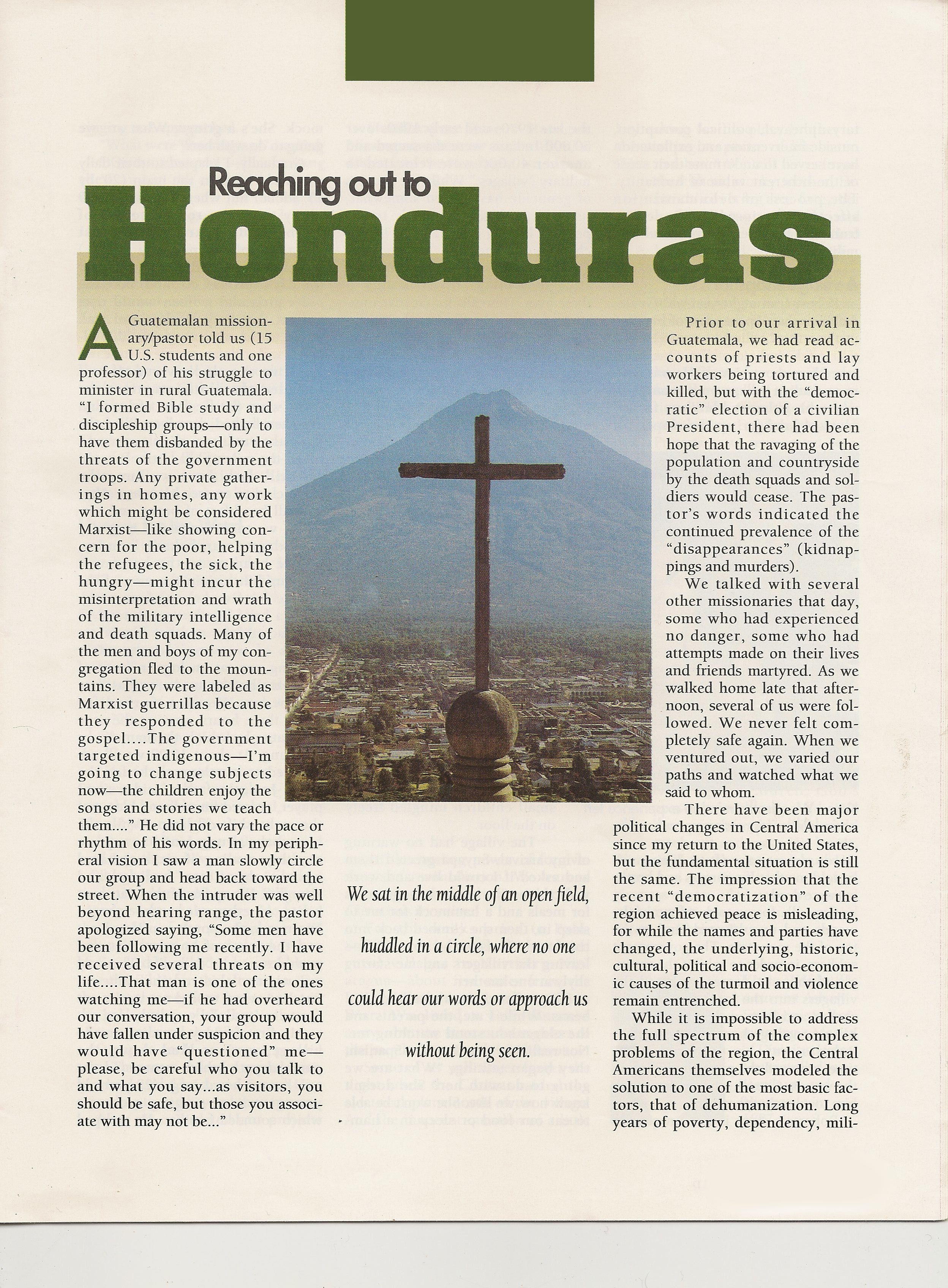
We sat in the middle of an open field, huddled in a circle, where no one could hear our words or approach us without being seen. A Guatemalan missionary/pastor told us (15 U.S. students and one professor) of his struggle to minister in rural Guatemala.
“I formed Bible study and discipleship groups – only to have them disbanded by the threats of the government troops. Any private gatherings in homes, any work which might be considered Marxist—like, showing concern for the poor, helping the refugees, the sick, the hungry—might incur the misinterpretation and wrath of the military intelligence and death squads. Many of the men and boys of my congregation fled to the mountains. They were labeled as Marxist guerillas because they responded to the gospel…. The government targeted indigenous—I’m going to change subjects now—the children enjoy the songs and stories we teach them…”
He did not vary the pace or rhythm of his words. In my peripheral vision, I saw a man slowly circle our group and head back toward the street. When the intruder was well beyond hearing range, the pastor apologized, saying, “Some men have been following me recently. I have received several threats on my life… That man is one of the ones watching me—if he had overheard our conversation, your group would have fallen under suspicion and they would have “questioned” me—please, be careful who you talk to and what you say…as visitors, you should be safe, but those you associate with may not be…”
Prior to our arrival in Guatemala, we had read accounts of priests and lay workers being tortured and killed, but with the “democratic” election of a civilian President, there had been hope that the ravaging of the population and countryside by the death squads and soldiers would cease. The pastor’s words indicated the continued prevalence of the “disappearances” (kidnappings and murders).
We talked with several other missionaries that day, some who had experienced no danger, some who had attempts made on their lives and friends martyred. As we walked home late that afternoon, several of us were followed. We never felt completely safe again. When we ventured out, we varied our paths and watched what we said to whom.
There have been major political changes in Central America since my return to the United States, but the fundamental situation is still the same. The impression that the recent “democratization” of the region achieved peace is misleading, for while the names and parties have changed, the underlying, historic, cultural, political, and socio-economic causes of the turmoil and violence remain entrenched.
While it is impossible to address the full spectrum of the complex problems of the region, the Central Americans themselves modeled the solution to one of the most basic factors, that of dehumanization. Long years of poverty, dependency, military upheaval, political corruption, outside intervention and exploitation have served to undermine their sense of the inherent value of humanity. The process of dehumanization affects all socio-economic levels, from the homeless to political and military leaders.
A village snapshot
Roberto, an eight-year-old Guatemalan orphan, spent most of this time in the streets selling his services as a tour guide and storyteller. One day, I asked him about himself. He was born in an Indigenous village on a mountain, where his father and brothers farmed plots of land far up the slopes. In words almost too soft to distinguish he told me that his parents and brothers were dead.
Guerrilla forces took refuge in the woods and uncultivated land at the top of the mountain. The government soldiers, in order to inhibit the resupply of the rebel forces, gathered the villagers into the local church, then shelled and burned the church, machine gunning those who escaped. Roberto, only six-years-old at the time, survived the purge by hiding in the woods. Church workers later took him to a local orphanage.
Roberto’s story is not unique. In the late 1970s and early 1980s over 50,000 native people were massacred and another 40,000 were relocated to military “villages.” While the process of genocide has slowed somewhat, its progress has been steady to the present, leaving over 125,000 indigenous children orphaned.
Christians in Central America struggle to bring Christ’s healing to these lives. This calls for creative ministries which help alleviate the immediate suffering through health care, food cooperatives, advocacy, etc. Only then can they focus on restoring some sense of self-worth. In my work with a family in rural Honduras, I found that even a relatively meager knowledge of Jesus Christ empowered them to look beyond their poverty to helping those in greater need.
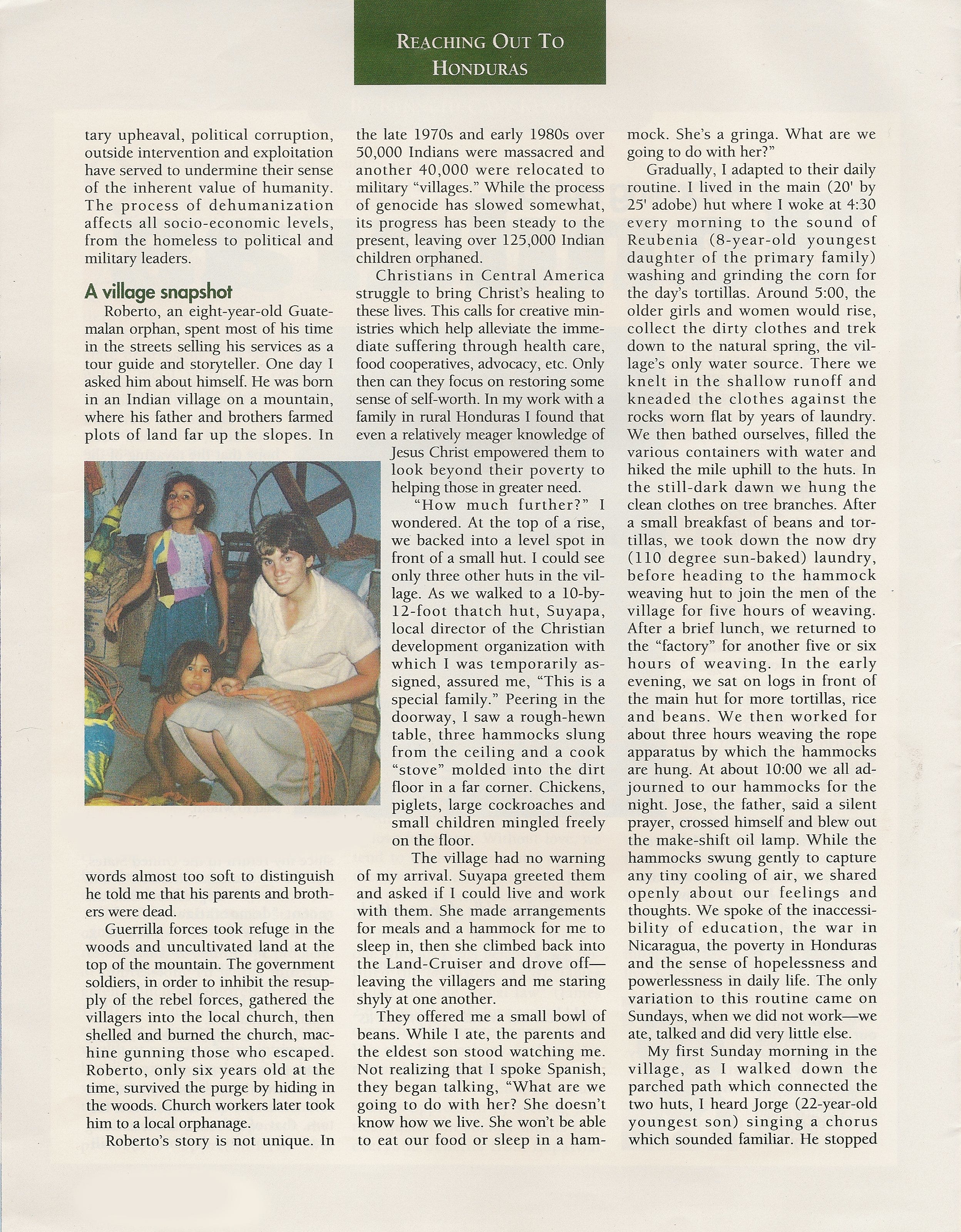
“How much further?” I wondered. At the top of a rise, we backed into a level spot in front of a small hut. I could see only three other huts in the village. As we walked to a 10-by-12-foot thatch hut, Suyapa, local director of the Christian development organization with which I was temporarily assigned, assured me, “This is a special family.” Peering in the doorway, I saw a rough-hewn table, three hammocks slung from the ceiling and a cook “stove” molded into the dirt floor in a far corner. Chickens, piglets, large cockroaches, and small children mingled freely on the floor.
The village had no warning of my arrival. Suyapa greeted them and asked if I could live and work with them. She made arrangements for meals and a hammock for me to sleep in, then she climbed back into the Land-Cruiser and drove off—leaving the villagers and me staring shyly at one another.
They offered me a small bowl of beans. While I ate, the parents and the eldest son stood watching me. Not realizing that I spoke Spanish, they began talking, “What are we going to do with her? She doesn’t know how we live. She won’t be able to eat our food or sleep in a hammock. She’s a gringa. What are we going to do with her?”
Gradually, I adapted to their daily routine. I lived in the main (20’ by 25’ adobe) hut, where I woke at 4:30 every morning to the sound of Reubenia (8-year-old youngest daughter of the primary family) washing and grinding the corn for the day’s tortillas.
Around 5:00, the older girls and women would rise, collect the dirty clothes and trek down to the natural spring, the villagers only water source. There we knelt in the shallow runoff and kneaded the clothes against the rocks worn flat by years of laundry.
We then bathed ourselves, filled the various containers with water upstream and hiked the mile uphill to the huts. In the still-dark dawn we hung the clean clothes on the tree branches. After a small breakfast of beans and tortillas, we took down the now dry (110 degree sun-baked) laundry, before heading to the hammock weaving hut to join the men of the village for five hours of weaving.
After a brief lunch, we returned to the “factory” for another five or six hours of weaving. In the early evening, we sat on logs in front of the main hut for more tortillas, rice, and beans. We then worked for about three hours weaving the rope apparatus by which the hammocks are hung. At about 10:00 we all adjourned to our hammocks for the night.
Jose, the father, said a prayer, crossed himself, and blew out the make-shift oil lamp. While the hammocks swung gently to capture any tiny cooling of air, we shared openly about our feelings and thoughts.
We spoke of the inaccessibility of education, the war in Nicaragua, the poverty in Honduras and the sense of hopelessness and powerlessness in daily life. The only variation to this routine came on Sundays, when we did not work—we ate, talked, and did very little else.
My first Sunday morning in the village, as I walked down the parched path which connected the two huts, I heard Jorge (22-year-old youngest son) singing a chorus which sounded familiar. He stopped singing as I approached.
“What were you singing? I asked.
“’Quien eres tu?’—it is a song they sing in the church,” he answered.
“Where did you learn it? Have you been to church?”
“No, it is too far away to attend, but sometimes we hear Mass on the radio.”
He headed into the hut, still speaking, “I have two books of choruses….”
While he hunted the books, I retrieved my mandolin. For the next hour or so, Jorge taught me his favorite Catholic choruses. The rest of the family gathered around and joined in. They revealed their understanding of God and of the Christian service as they explained the meaning of the various lyrics.
Hungry for the Word
Another Sunday, as we relaxed in our hammocks, I pulled out my Spanish Bible.
After a while, Jorge asked, “What are you reading?”
“The Bible,” I answered.
“In Spanish?”
“Yes.”
Rita perked up and asked excitedly, “Could you read it to us?”
“Yes, any particular passage?”
“Jesus tells a story about a Samaritan….” After paraphrasing the passage she asked, “Could you read it?”
I turned to Luke 10 and read it to them.
“I’ve never read from a Bible before,” Jorge said. “Could I read it?”
I handed him the Bible. He found the parable of the prodigal son and haltingly began to read aloud. When he finished, he asked if he could borrow the Bible for the afternoon. For the next three of four hours he sat in the back corner of the hut on a sack of corn and read the Bible.
Suyapa’s early assurance proved true. They were indeed a special family who loved Christ and served Him according to and beyond their means.
After we completed our projects in Honduras, we flew to Managua, Nicaragua, where we met with other Christians.
In Nicaragua, we experienced the healing power of forgiveness and reconciliation. We learned the value of standing with other Christians in unity.
For the weeks prior to Palm Sunday, we had worked in isolated rural villages in Northern Nicaragua—about five miles from the front lines of the, then active, Contra War. We lived a safe distance away—but the sons and daughters of the people we stayed with did not.
Some of us will never forget the night when the Contras raided the electrical plant north of the village. And the innocent question of a little boy asking for his older brother or the wailing response of his sister “He’s in a box.” We will never forget their short, stocky mother, her hands covering her face, her body shaking with sobs and cries to God. The soldiers had brought her dead son in earlier that morning.
These images haunted our minds as we entered the Nicaraguan Church on Palm Sunday. We were painfully aware of our identity as citizens of the United States. We knew that we were very different from the people of the congregation. White, wealthy (by their standards), English-speaking, Protestant: we represented power and prosperity in the face of their struggle for survival.
The service began with songs or praise and worship. Then came the “Passing of the Peace”—a time to greet one another and to unite in God’s love. We held back, not wanting to invade their peace, but soon tears streamed down our faces as person after person came to us—to hug us, to welcome us, to share their gracious love with us. One by one, the entire congregation came. In their warm welcome, we caught a glimpse of God’s grace and reconciliation.
That evening, in the midst of the Nicaraguan Church, God’s presence was very real, His love very tangible. We could reach out and grasp His hands. We could reach out and hug his peace and joy. God’s love and forgiveness surrounded us as we united with our Nicaraguan brothers and sisters in Christ.
--The Asbury Herald, Fall, 1994
I remember the article (and your trip, of course!) Nice to read it again.